

Vibration Isolation in Metrology: Ensuring Precision in High-Stakes Measurements
The Critical Role of Accuracy and Precision in Metrology
Metrology, the science of measurement, underpins research, manufacturing and quality control in countless industries, including aerospace, semiconductor manufacturing, medical devices, and pharmaceuticals. Accurate and precise measurements are foundational components of scientific repeatability and product quality. Accuracy refers to how close a measurement is to the true value, while precision indicates the consistency of repeated measurements. Together, they ensure reliability and comparability of products and data across industries and research fields. In manufacturing, metrology enables consistent manufacture of critical components that are designed to extremely tight tolerances, such as high-performance optics or semiconductor wafers. Calibration to highly accurate international standards ensures that parts and subcomponents from around the world fit seamlessly together upon assembly, making today’s global supply chains possible. Accurate and precise measurements are also critical to quality, ensuring products consistently meet specifications and perform as expected.
In critically sensitive industries like aerospace, semiconductor manufacturing, and medical device production, even the smallest deviation can lead to significant consequences, from product failures to safety risks. These industries operate under stringent standards and regulations that require carefully calibrated measurement devices, validated processes, and statistically significant quality control testing. The goal of metrology, and international standards such as ISO 17025, is to eliminate uncertainties in measurement, providing a solid foundation for innovation and quality assurance that allows manufacturers to:
- minimize rework
- minimize waste (scrap)
- improve product quality / integrity
- improve product safety
- minimize risks to customers / passengers / patients
Environmental Challenges Affecting Precision Measurements

Precision measurement tools have been developed to meet the demands of ever more exacting measurement requirements. Today’s microbalances, coordinate measuring machines (CMMs), interferometers, profilometers, and electron microscopes are capable of operating within microgram, micrometer, nanometer, or even angstrom-level tolerances. The extreme sensitivity of these delicate measurement devices makes them sensitive to even the smallest environmental influences. Well-designed metrology laboratories prioritize environmental controls to ensure accurate and reliable measurements, focusing on factors like temperature, humidity, and vibration control, as well as efficient layout and equipment placement. However, even in very controlled laboratory environments, metrology equipment remains vulnerable to external disturbances, including:
- Mechanical Vibrations: Low-frequency vibrations from HVAC systems, foot traffic, and machinery can compromise accuracy.
- Acoustic Noise: Sound waves induce vibrations in components, leading to errors.
- Air Currents: Subtle shifts in air pressure can impact measurement stability.
- Thermal Fluctuations: Temperature variations cause material expansion, affecting dimensional accuracy.
Among these, vibrations pose the greatest challenge. Vibration has the potential to fundamentally undermine both the accuracy and precision of measurements by introducing both random and systematic errors. Random vibrations can cause unpredictable fluctuations in readings, affecting precision of results. Systematic vibrations, if not properly accounted for, can introduce a consistent bias in the measurements, leading to inaccuracies by shifting the measured values away from the true value. It is nearly impossible to eliminate all sources of vibration from the laboratory and surrounding building environments. For example, HVAC systems are necessary to control temperature and humidity variations in laboratories. Human activity, including walking, talking, closing doors, shutting drawers, etc., is virtually unavoidable, as is the operation of supporting machinery and infrastructure such as motors, pumps, compressors, plumbing, and elevators. Since even tiny, imperceptible vibrations can have large impacts on measurement accuracy and precision, sensitive equipment must be protected from the environment using vibration isolation technologies.
Vibration Isolation Solutions: Technologies for Mitigating Disruptions

Vibration isolation systems stabilize metrology tools by damping mechanical vibrations before they reach the equipment. This can be accomplished at the point of manufacture by directly integrating isolation technology into the equipment’s design, and/or at the point of use by installing the equipment on a suitable vibration isolation platform, workstation, or optical table. In most cases, installing equipment on a low frequency, vibration-free isolation system will allow your equipment to perform flawlessly in ambient shock and vibration environments. Ultra-rigid work surfaces may be used in combination with vibration isolators for critically sensitive applications, especially in cases where the equipment’s movements may cause resonance on the work surface.
Conventional isolators are constructed using metal springs or rubber blocks. They have low internal damping and tend to be effective only at frequencies near 10 Hz. Also, they provide almost no isolation at frequencies above 30 Hz because of harmonic standing waves occurring at sonic velocities in the metal or rubber.
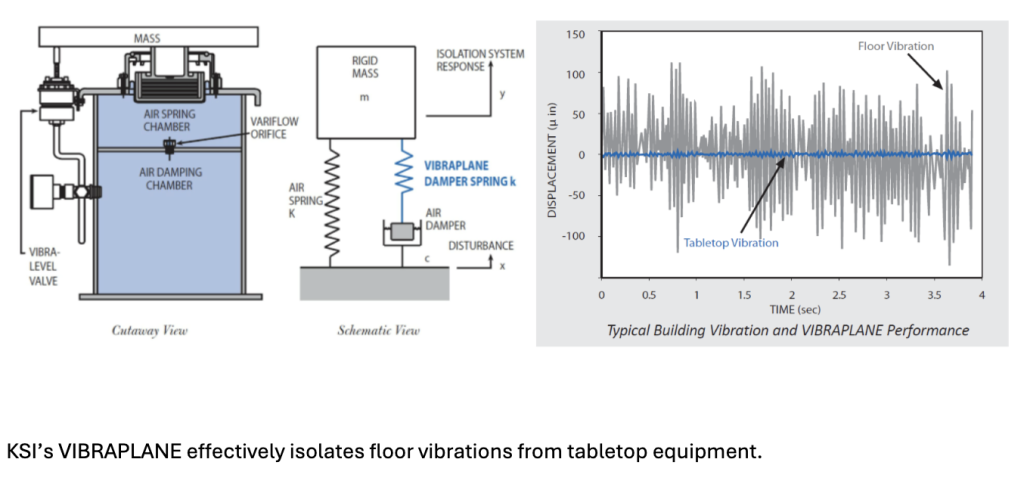
Dual-chamber pneumatic isolators, also known as air mounts, are an effective and maintenance-free solution for a wide range of high-precision applications. Kinetic Systems’ VIBRAPLANE air mounts utilize a frictionless rolling diaphragm air seal to support a load-carrying piston in conjunction with dual air chambers as the spring and damping medium (see figure). The air spring stiffness is a function of the combined air volume of the dual chambers, providing the very low stiffness that is required to obtain the low natural frequency (1 to 2 Hz) necessary for effective vibration isolation. Harmonic standing waves cannot occur in the VIBRAPLANE System due to its dual air chamber internal damping design.
Case Studies: The Impact of Vibrations on Accurate and Precise Metrology in Critical Industries
Pharmaceutical Manufacture:
The pharmaceutical industry protects patient safety by maintaining the integrity and quality of its products throughout the manufacturing and testing processes. During formulation, active pharmaceutical ingredients and other components must be accurately measured using calibrated devices to ensure the final product is prepared to exact specifications. Filling and packaging processes use calibrated measuring systems to ensure that bulk products are allocated into final product configurations with the correct counts, weights, and volumes. In addition, Quality Control testing is performed using precise analytical instrumentation, calibrated balances and volumetric measuring equipment to verify final products will deliver the correct potency and purity of life-saving medications to patients. Vibrations can cause uncontrolled variations in critical quality attributes such as tablet weight, fill volume, potency, or purity. These inconsistencies can cause expensive product failures, drive up the cost of medications, or even compromise the safety and efficacy of the pharmaceutical products.
Aerospace:
The aerospace industry operates under exceptionally high-precision requirements in the manufacturing of aircraft components to ensure both performance and structural integrity. Vibration plays a critical role in this sector, particularly concerning the balancing of rotating parts within aircraft engines. If the measurements taken during the balancing process are inaccurate due to external vibrations affecting the metrology equipment, it can lead to residual imbalance. This imbalance can then manifest as excessive vibration during engine operation, potentially causing fatigue and eventual failure of critical engine components.
Semiconductor:
The semiconductor industry stands out for its extreme sensitivity to vibration, particularly in the advanced manufacturing processes required for creating increasingly smaller and more complex integrated circuits. Lithography, deposition, and the intricate quality control processes at the nanoscale are all highly susceptible to even the slightest mechanical disturbances. Vibration has emerged as a major impediment to achieving maximum yield and efficiency in the fabrication of cutting-edge semiconductors. To overcome these challenges, the industry relies on sophisticated vibration control systems and point-of-use isolation technologies to ensure the stability and precision of critical equipment. If vibration affects the metrology equipment used to inspect semiconductor wafers during production, it can lead to the acceptance of wafers with subtle defects, or false rejection of good parts, reducing yields and driving up costs.
The Impact of Vibrations on Metrology Equipment
Distortion of Measurement Equipment:
Vibration can induce both temporary and permanent distortions in the sensitive components of metrology equipment, directly impacting their calibration and accuracy. For instance, prolonged exposure to vibration can cause mechanical stress and fatigue in the wires of temperature sensors like thermocouples and Resistance Temperature Detectors (RTDs). This can lead to open circuits, noisy signal outputs, or even a gradual shift in the sensor’s calibration curve (decalibration), thereby affecting the accuracy of temperature measurements that are often critical in other metrology processes. In optical metrology instruments such as microscopes, spectrometers, and coordinate measuring machines (CMMs) utilizing optical probes, vibration can cause subtle misalignments of the optical elements. These misalignments can distort the image or the measurement beam, leading to inaccuracies in dimensional measurements or surface characterization. Furthermore, vibration can contribute to the wear and tear of mechanical components within measurement equipment over time. This gradual degradation of performance can manifest as increased measurement variability or a systematic drift in calibration, ultimately compromising the reliability of the equipment.
Impact on Stability and Alignment:
Maintaining stability and precise alignment is crucial for accurate measurements in many metrology applications, and vibration can significantly impede these requirements. Vibration can cause instability in measurement platforms, such as those used in high-precision CMMs or lithography equipment, leading to unwanted motion errors during the data acquisition process. This instability can result in blurred images, distorted measurement points, or inconsistencies in the measured dimensions. Similarly, vibration can interfere with the proper alignment of the part being measured relative to the measurement instrument. If the object is vibrating, it can be challenging to ensure it is positioned correctly and remains stable throughout the measurement process, especially when dealing with tight tolerances. The semiconductor industry, with its nanometer-scale manufacturing requirements, faces significant challenges in maintaining the stability and alignment of its high-resolution metrology equipment operating in environments that can be susceptible to even minute vibrations. Any vibration-induced instability in equipment used for lithography, etching, or inspection can lead to critical errors in the fabrication process, resulting in defective chips.
The Link to Product Failure: Real-World Scenarios and Potential Consequences
Inaccurate Measurements Leading to Acceptance of Non-Conforming Products:
Vibration-induced errors in metrology can have serious consequences, most notably leading to the acceptance of products that do not conform to required specifications. During quality control inspections, if vibration affects the measurement equipment, it can mask subtle but critical dimensional inaccuracies or defects in the manufactured parts. This can result in faulty parts being deemed acceptable and moving further down the production line or even reaching the end customer.
Safety Hazards and Economic Losses:
The acceptance of non-conforming products due to vibration-related metrology errors can lead to a cascade of negative consequences, including significant safety hazards and substantial economic losses. If faulty products reach consumers or are integrated into larger systems, they can lead to operational failures and performance issues. In safety-critical industries like aerospace and medical devices, such failures can have catastrophic consequences. The economic impact can be substantial, including the costs associated with product recalls, rework of defective items, increased scrap rates, and warranty claims resulting from manufacturing defects that were missed due to inaccurate metrology. Furthermore, the reputational damage associated with product failures can have long-lasting effects on a company’s brand and customer trust.
Choosing the Right Vibration Isolation Solution for Metrology
When evaluating a vibration isolation table, lab managers should consider:
- Equipment manufacturer’s requirements / specifications
- Load capacity (weight) and surface area requirements for the equipment,
- Level of vibration and noise in the environment,
- Performance requirements for current and future applications,
- Size limitations in the laboratory space,
- Cleanroom or other special requirements,
Key Selection Factors
- Performance Capabilities: Consider resonance frequency, damping efficiency, and active vs. passive isolation.
- Load Capacity: Ensure the isolation system is optimized for the instrument’s weight and distribution.
- Price vs. Performance:
- Passive-air isolation for systems requiring infrequent manipulation or where reliable compressed air is not available
- Active-air systems with rapid self-leveling for reduced downtime
- Broadband-damped optical tables and breadboards for general laboratory use
- Optical tables with tuned damping for extremely sensitive applications
Do I Need to perform a vibration survey?
Using advanced data acquisition systems, high sensitivity accelerometers, and laptop computers, trained engineers can perform a vibration survey to accurately measure and analyze data specific to your location. However, for most applications, you do not need to know the specific environmental details. Unless your work environment is unusually prone to dramatic vibration fluctuations, pre-engineered, all-purpose, low frequency, vibration-free tables and platforms for tabletop and floor mounted equipment will perform perfectly well for you.
Kinetic Systems Isolation Technologies:
- Passive-Air Isolation: Cost-effective, uses dual-chamber pneumatic dampers to absorb vibrations without external power or compressed air.
- Active-Air Isolation: Same dual-chamber design for superior isolation performance, plus self-leveling capability. Requires connection to compressed-air source. Ideal for ultra-sensitive instruments, reducing low-frequency disturbances.
- Optical Tables and Breadboards: Ultra-flat and ultra-rigid work surfaces, designed to be used with Kinetic Systems isolators for the most critical applications, at a fraction of the cost and weight of granite. Available in a variety of thicknesses and damping levels, with metric or imperial threaded holes.
Conclusion: Enhancing Metrology with Vibration Isolation Technology
Accurate, reproducible, metrology with calibrated traceability to international standards is indispensable for ensuring the quality, reliability, and safety of manufactured products across all industries. The pervasive presence of vibration in industrial environments poses a significant challenge to achieving and maintaining the required levels of measurement accuracy and precision. Vibration-induced errors in measurement can lead to the acceptance of non-conforming products, resulting in safety hazards, substantial economic losses through recalls and rework, and damage to brand reputation. Effective management of vibration in metrology environments is therefore paramount. This requires a multi-faceted approach encompassing facility design, careful selection and installation of metrology equipment, strict environmental controls, regular equipment calibration and maintenance, and most importantly, the implementation of appropriate vibration isolation techniques. Vibration isolation is essential for achieving reliable, high-precision measurements and maintaining calibration integrity. Dual-chamber pneumatic isolators, such as Kinetic Systems’ VIBRAPLANE air mounts, are an effective and maintenance-free solution for a wide range of high-precision applications.
Take the Next Step
Kinetic Systems specializes in advanced vibration isolation solutions tailored for metrology applications. Review our catalog and contact us today to explore how our solutions can enhance the precision and reliability of your measurements. One of our engineers will ask you a few simple questions and quickly get you a cost-effective vibration isolation solution that will work for you.
comments
comments for this post are closed