
Why Your Microscope’s Performance Depends on the Right Vibration Isolation Table
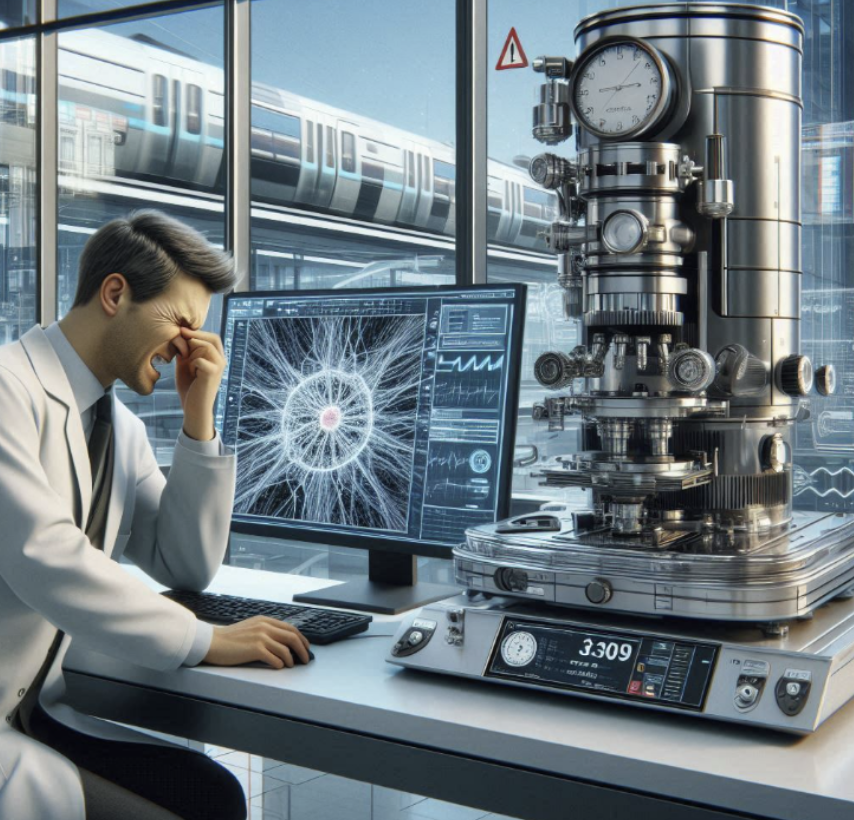
The Silent Disruptor: How Vibrations Undermine Precision in Microscopy
Precision microscopy is an indispensable tool in modern research and industrial laboratories, revealing details that drive advancements in medicine, materials science, and engineering. From biomedical research to semiconductor fabrication, the ability to observe, analyze, and measure highly resolved structures with precision is critical. However, achieving the highest levels of precision in microscopy requires absolute stability. Microscopes are sensitive to vibrations that are imperceptible to human researchers. Even the smallest environmental vibrations can severely compromise imaging accuracy, making vibration isolation a necessity for high-performance microscopy.
Problem: External vibrations degrade image resolution and data accuracy.
Vibrational performance degradation in microscopy is typically characterized by a failure to achieve the expected level of image sharpness, resolution, and measurement accuracy. Put simply, the root cause of these failures is that vibrations cause movement of the sample, the optical elements, or both. The specific mechanism of performance degradation varies by instrument, technique, and whether the vibration is in the horizontal or vertical direction. For example, scanning electron microscopes and transmission electron microscopes are specifically sensitive to horizontal vibrations, while scanning probe microscopy techniques are more sensitive to vertical vibrations.
Here are some examples of how different microscopy techniques are variously sensitive to vibrations:
Confocal Laser Scanning Microscopy (CLSM) – Vibrations can cause axial displacement of the focal plane, leading to blurring and loss of optical sectioning ability.
Atomic Force Microscopy (AFM) – Since AFM relies on a sharp probe scanning a surface with nanometer precision, vibrations can introduce artifacts or misalignment in topographical measurements.
Fluorescence Microscopy (Widefield & Structured Illumination Microscopy – SIM) – Vibrations can lead to slight shifts in the sample position, causing motion blur, misalignment in structured patterns, and loss of resolution.
Super-Resolution Microscopy (STORM, PALM, STED) – These techniques depend on precise localization of single molecules, and vibrations can disrupt image reconstruction, reducing spatial accuracy.
Two-Photon Microscopy – Due to its reliance on precise focal plane positioning for deep tissue imaging, vibrations can shift the focal point, leading to degraded resolution and signal loss.
Transmission Electron Microscopy (TEM) – Vibrations can cause sample drift, leading to streaking artifacts and loss of image sharpness, particularly in high-resolution applications.
Cryo-Electron Microscopy (Cryo-EM) – This technique requires extreme stability to resolve molecular structures, and even small vibrations can shift the sample or defocus images, reducing the ability to reconstruct high resolution structures.
Interference Microscopy (e.g., Differential Interference Contrast, DIC) – Vibrations can alter the phase shift patterns used for contrast generation, affecting image clarity and introducing artifacts.
Scanning Electron Microscopy (SEM) – While less sensitive than TEM, SEM still requires stability for precise beam scanning, and vibrations can lead to distortions in image formation.
Total Internal Reflection Fluorescence (TIRF) Microscopy – TIRF relies on a highly stable evanescent wave for excitation; vibrations can alter the angle or depth of penetration, impacting signal intensity and image clarity.
Solution: Vibration Isolation Tables Provide Stability in an Unstable World
High-precision microscopy requires extreme stability to capture clear and accurate images, particularly in high resolution techniques that require longer scan durations. Maintaining the necessary stability presents a significant challenge in real-world laboratories. Careful laboratory design, instrument location selection, and work practice controls can help reduce vibration sources, but they cannot be eliminated. Most laboratories are busy workplaces, filled with the movements of people and machines, located in buildings with active infrastructure, and surrounded by bustling cities with roads and rail traffic. If you can’t remove the vibrations from the laboratory environment, you must isolate sensitive equipment using vibration isolation technology.
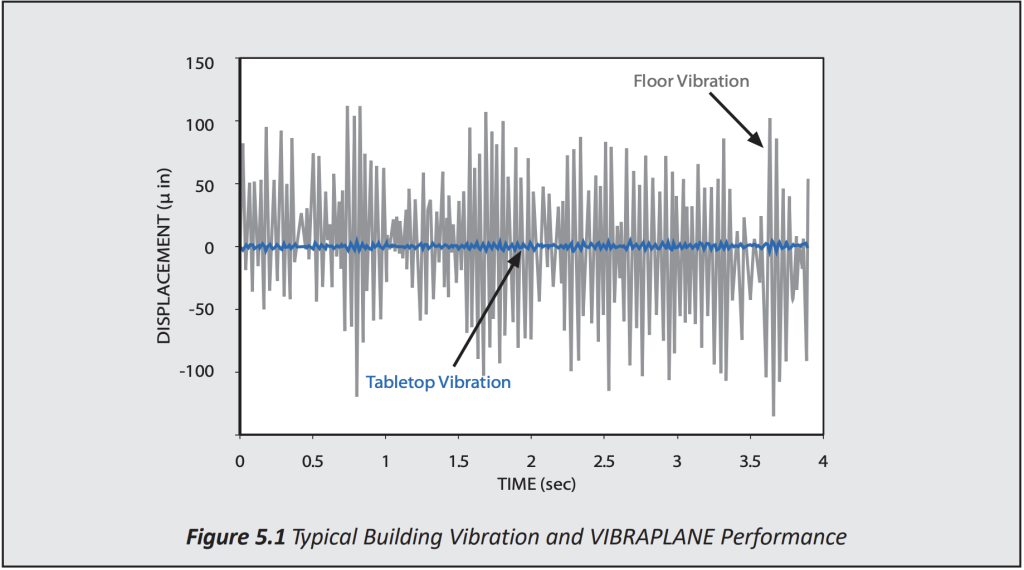
Vibration isolation is the single most important installation consideration to ensure you get maximum performance from any microscope. A quality vibration isolation table, such as a KSI VIBRAPLANE system, can virtually eliminate concerns about floor vibration, ensuring accurate and repeatable results. Figure 5.1 shows a typical time sample of a severe building vibration environment (Floor Vibration) compared to the performance of the VIBRAPLANE isolation table (Tabletop Vibration). Without a vibration isolation table, optical equipment operating in this environment would experience low frequency jitter and high frequency image blur and line thickening. In the short term, this leads to inconsistent and unreliable performance. Over the long-term, vibration causes excessive wear, increased maintenance costs and instrument downtime.
It should be noted that although some microscope manufacturers integrate a degree of vibration isolation technology into their equipment, these built-in systems are not designed to compensate for all environmental vibrations. To get the best performance from your microscope, its exposure to ambient vibration must be reduced significantly by using a vibration isolation table at the point of installation. Starting from a stable platform allows the microscope to operate to its full precision capabilities.
In addition to isolating your instrument from environmental (floor) vibrations, it’s also important to control vibrations that originate from the equipment work surface itself. Vibration disturbances can be caused by cooling fans, pumps, vacuum system tubing, or rotating devices. If not controlled with effective damping, high frequency vibrations can propagate along the horizontal surface of the table and negatively impact performance. KSI offers a variety of work surface damping options, including rigid structural platforms and passive damping that may be tuned for the application and tabletop load.
Kinetic Systems Vibration Isolation Workstations and Tables
KSI is a global leader in the application and development of advanced low-frequency vibration control systems that offer vibration-free working environments for sensitive microscopy equipment. We offer Vibration Isolation Tables and Workstations for virtually any application, whether for a cleanroom, research laboratory, or quality control room. Our active-air and passive-air solutions are designed to meet a wide range of performance capabilities, load capacities, and budgets. Our mission is to find the best solution for your laboratory, whether it is available in our current catalog or a custom system.
Contact one of our sales engineers to discover the best solution for your vibration isolation requirements. We’ll help ensure you get the most value from your instrument while ensuring your research is not compromised by floor vibrations.
Stabilize your Microscope Investment
For any industry or laboratory relying on high-precision microscopy, vibration isolation is not a luxury, it is a necessity. Investing in a high-quality vibration isolation table ensures that environmental disturbances do not compromise research, innovation, or manufacturing quality. Whether in academia, healthcare, or industrial applications, the right isolation solution can make the difference between breakthrough discoveries and flawed results.
By prioritizing stability, researchers and professionals can unlock the full potential of microscopy, achieving unparalleled accuracy in their work. Don’t let vibrations stand in the way of precision. Equip your lab with the stability it deserves.
comments
comments for this post are closed